Adding and subtracting within 20 is one of the big goals of first grade, and second graders keep building on it: multi-digit problems, word problems, larger numbers. A child who knows right away that 8 + 5 = 13 has more attention left for everything else.
Knowing a fact quickly doesn't mean memorizing a chart without understanding it. Children who are fluent with math facts almost always rely on a few strategies: shortcuts that turn a hard calculation into an easy one. Here are the six we use in our workbooks, with examples you can try at home.
1. Start with the larger number
For 2 + 6, many children start at 2 and count on six times. It's slow, and it's easy to lose track along the way.
The habit to build: start with the larger number and count on the smaller one. Start at 6, then count 7, 8. So 2 + 6 = 8.
This strategy rests on an important idea: in addition, the order of the numbers doesn't change the sum. 2 + 6 and 6 + 2 are the same. Let your child check it with counters; discovering it beats being told a rule.
2. Make 10
This is probably the most useful strategy for crossing ten. For 8 + 5:
- 8 needs 2 more to make 10;
- split 5 into 2 and 3;
- 8 + 2 = 10, then 10 + 3 = 13.
It depends on knowing the pairs that make 10: 1 and 9, 2 and 8, 3 and 7, 4 and 6, 5 and 5. Those are the first facts worth practicing. Ten fingers are the perfect tool: hold up 7 fingers — how many are still down?
3. Use doubles
Children often learn doubles before other facts: 5 + 5 = 10, 6 + 6 = 12, 7 + 7 = 14. They make great anchors.
6 + 7 is 6 + 6, plus 1: 13. And 8 + 7 is 7 + 7, plus 1: 15.
Hunt for "near doubles" together in a set of problems. Your child learns to look at a problem before diving in, which is a skill in itself.
4. Go back to 10 to subtract
This is "make 10" in reverse. For 13 − 5:
- take away 3 first to get back to 10;
- there are 2 left to take away;
- 10 − 2 = 8.
A number line from 0 to 20 drawn on a sheet of paper makes the path very visual: two jumps instead of five small steps back.
5. Connect addition and subtraction
7 + 5 = 12. So 12 − 7 = 5 and 12 − 5 = 7. These three numbers form a fact family: when you know one addition fact, you also know two subtraction facts.
That matters, because subtraction is often harder for children. Faced with 12 − 7, they can ask, "7 plus what makes 12?" Missing-number problems such as 7 + □ = 12 practice exactly that kind of thinking.
6. Check another way
Your child got 9 for 14 − 5? Check it: 9 + 5 = 14. Correct.
Checking isn't a sign of doubt; it's what good problem solvers do. A fun way to practice: give problems that are already solved, but wrong, and ask your child to fix them. "6 + 3 = 8 — what went wrong?" Children love being the one who corrects the answer.
How to practice without pressure
Strategies take a few minutes to understand; practice makes them automatic. A few guidelines to keep that practice pleasant:
- Keep sessions short. One set of 10 problems can be enough. It's better to stop while your child is still focused than to push until they're tired of it.
- Regular beats long. A few short sessions a week work better than one long catch-up session, and daily practice isn't required.
- Supports are allowed. Fingers, counters, a number line: they build understanding, and children drop them on their own once they no longer need them.
- Ask for explanations. "How did you figure that out?" Explaining a strategy out loud makes it stick better than ten silent problems.
- A mistake is information. It shows what still needs practice. Go over it together, calmly.
- Timing is optional. Some children enjoy watching their time drop from one week to the next; others find the clock stressful. If so, leave it out: understanding matters more than speed.
- Move forward in stages. Addition within 10 first, then subtraction within 10, before moving up to 20. Going back to an earlier stage is never a failure.
A workbook to support these sessions
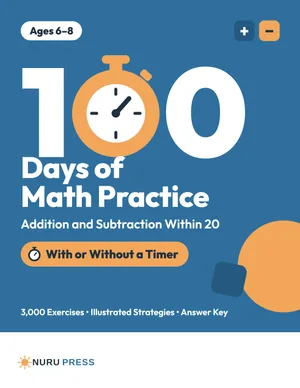
We designed 100 Days of Math Practice around this progression: five stages, from addition within 10 to mixed addition and subtraction within 20, each introduced by an illustrated strategy page. Every session offers three sets of 10 problems (solve, find the missing number, fix the wrong answer), with a score tracker and a complete answer key. The timer is optional, with no target time.
The workbook comes in two separate editions: in English for ages 6–8, and in French, 100 jours de calcul, for families who also practice in French.